
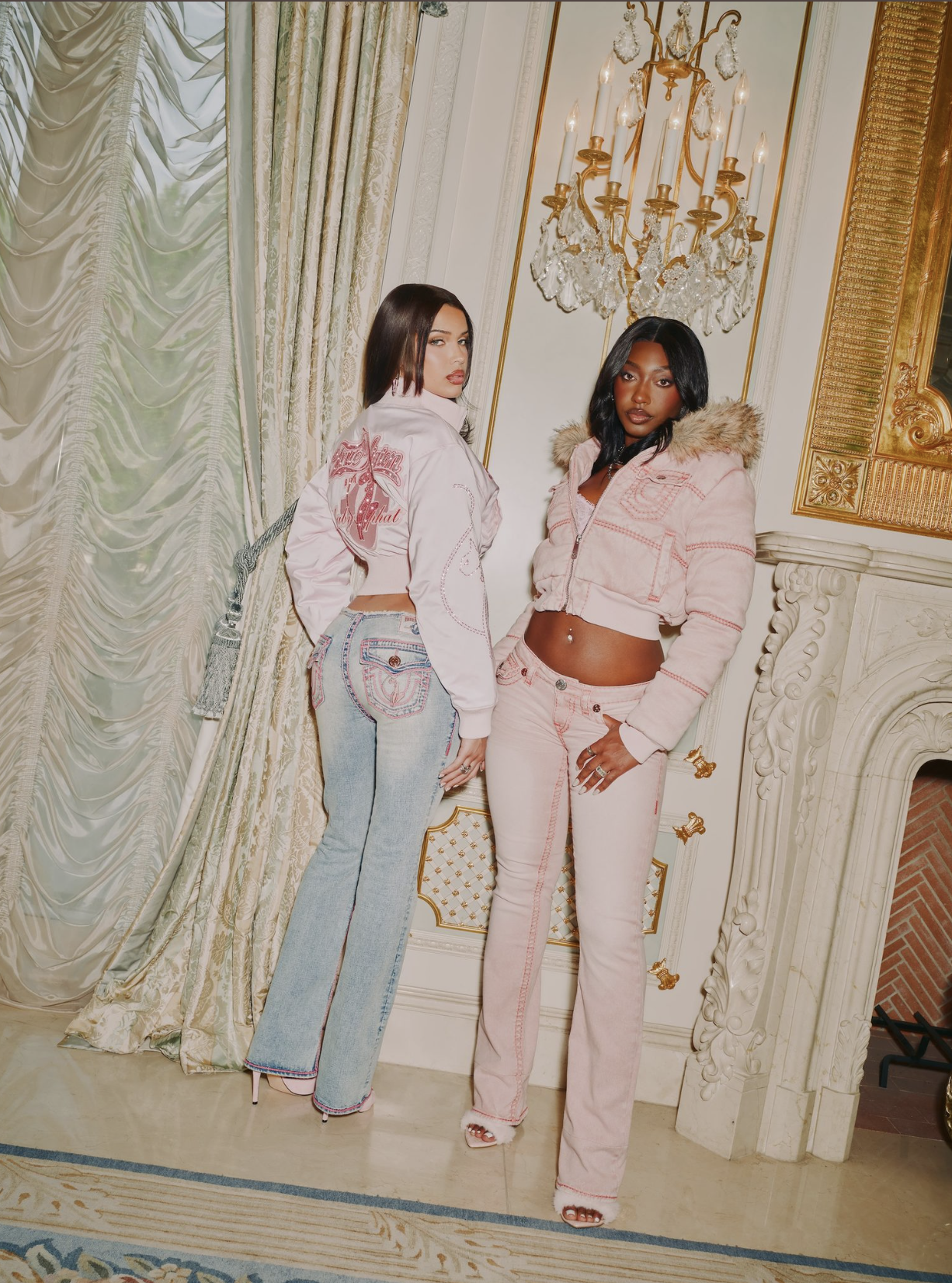
Photo Credit:True Religion
I knew Y2K fashion had crossed from nostalgia into a full retail comeback when I walked into a TJ Maxx in a very small college town and saw Baby Phat everywhere.
Not one lonely T-shirt tucked into a clearance rack. Baby Phat galore.
Juicy Couture was there too, and yes, I left with a matching Juicy Couture set, a makeup bag and a pair of mules. That is a separate story—and possibly proof that I should not be left alone in TJ Maxx. But seeing both brands in a store far outside a fashion capital made something click for me. This comeback is no longer happening only on resale apps, celebrity mood boards or TikTok. The clothes are back in regular stores, in regular towns, waiting for women who remember the first era and younger shoppers discovering it for the first time.
Now True Religion and Baby Phat are making that return official with their first collaboration, arriving October 27 on TrueReligion.com and BabyPhat.com. The limited-edition collection brings together two brands that helped shape early-2000s style: True Religion’s bold denim, horseshoe stitching and recognizable fits with Baby Phat’s hot pink, crystals, satin, furry trim and cat logo.
And honestly? This pairing makes sense.
Baby Phat Never Needed to Be Rediscovered
Baby Phat launched in 1999 under Kimora Lee Simmons and gave women—especially Black women—a version of streetwear that was glamorous, fitted and completely unapologetic. It did not ask us to choose between looking sexy and looking powerful. The tiny cat logo, rhinestones, low-rise jeans and fitted tops created a language that felt instantly recognizable.
That is why I have mixed feelings whenever Baby Phat is treated like a forgotten trend that suddenly reappeared. For many of us, it never disappeared from our fashion memory. It is part of the same early-2000s universe as glossy lips, oversized sunglasses, airbrushed denim and the velour sets I associate with the Cheetah Girls era, Juicy Couture and every celebrity airport photo we saved before “airport style” became a content category.
Back then, a brand could feel unavoidable without social media. You saw it in music videos, on red carpets, in magazines and at the mall. Everybody was receiving the same visual message at roughly the same time. Today, a comeback can be happening everywhere and still feel strangely quiet because our feeds are so fragmented.
That is what I wish were different about Baby Phat’s return. I want the brand to receive the kind of visible, sustained push it had the first time not because it needs nostalgia to survive, but because its influence deserves to be introduced to a new generation with the same confidence it gave us.
If you want the wider cultural context, our roundup of iconic Black fashion moments shows how much of today’s style language was shaped by Black music, television and celebrity culture long before the algorithm renamed it a trend.
Why True Religion Is the Right Partner
True Religion belongs in this conversation because its denim was never designed to disappear into an outfit. The contrast stitching, horseshoe pockets, bootcut shapes and heavy branding made the jeans the point.
Baby Phat approaches fashion with the same confidence. Both brands understand that sometimes you want a piece to announce itself before anyone has time to ask where it came from. One built that identity through denim construction; the other used glamour, curves, color and shine.
The collaboration works best where those signatures meet. The preview shows low-rise bootcut, flared and baggy jeans alongside an airbrushed denim style, a shrunken satin bomber, pink denim and puffer jackets, zip-front layers, furry trim, fitted baby tees and coordinated sets. There is also a denim-and-fur mini skirt and halter combination that feels like somebody opened a 2003 celebrity closet and gave it better campaign lighting.
This is more interesting than placing two logos on a basic sweatshirt. The clothes make a visual argument for why these brands belong together.
The Pieces That Already Stand Out
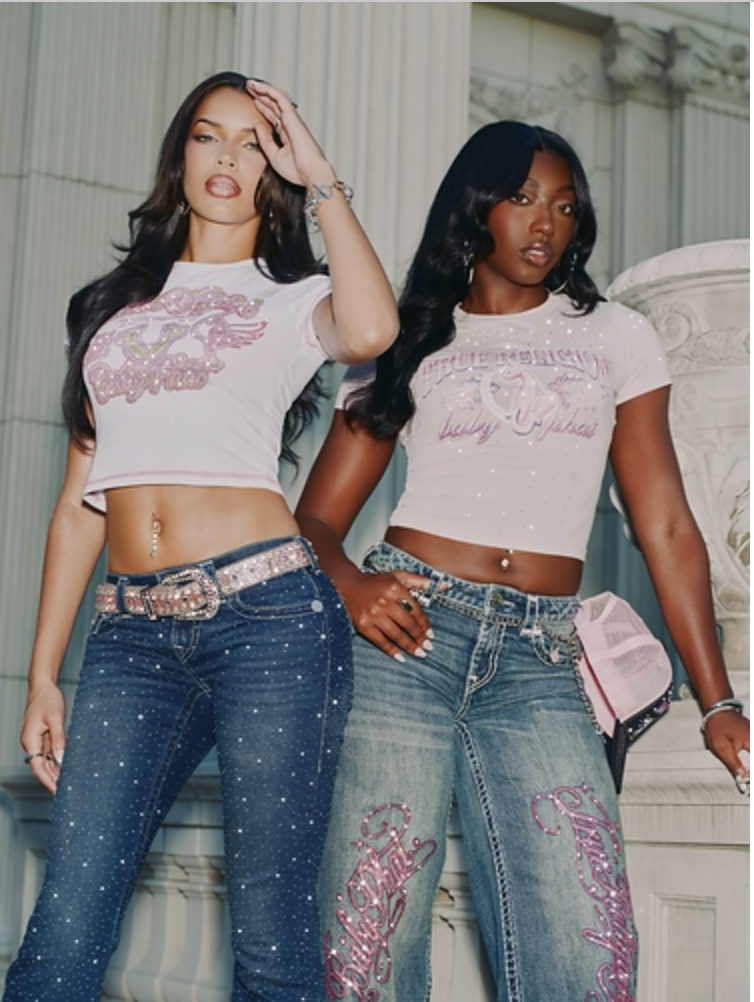
Kayda Bosse and Aniya Harvey for True Religion & Baby Phat Collection
The airbrushed baggy jeans are the first piece I want to see up close. Airbrushing is so specific to the era, but the roomier fit keeps the idea from feeling like a costume. Styled with a fitted baby tee or the cropped satin bomber, the proportion does what good Y2K styling always did: one piece hugs the body while the other creates the attitude.
The pink puffer is another obvious standout. Baby Phat has always understood the power of pink as a statement rather than a sweet little accent, and putting that color onto a practical winter shape gives the collection life beyond a themed party. I can already see it with dark denim, a fitted black top and a small shoulder bag.
The denim-and-fur set is pure drama. It will not be the most practical option, and that is exactly why it belongs here. A collaboration between these two brands should include at least one look that makes you want to plan somewhere to wear it.
I also like the coordinated looks because matching pieces were central to the era. They create the instant outfit satisfaction of a tracksuit without forcing every customer into velour. As someone who just bought a Juicy Couture set on sight, I clearly respect the power of a matching look.
My one hesitation is the commitment to low-rise bottoms across the collection. It is honest to both brands’ history, and the preview includes bootcut, flared, baggy and micro-mini shapes. Still, not every woman who wants to participate in this comeback wants the original rise back too. I would love to see the same stitching, pink, crystals and attitude offered in more rises as the partnership develops.
The final test will be fit. True Religion and Baby Phat are selling a silhouette-driven collection, so the size range, stretch, inseams and rise measurements matter just as much as the campaign images. Those details—and the prices—had not been published when this story was written. We will update this article when the collection goes live.
Aniya Harvey and Kayda Bosse Make the Campaign Feel Current
Love Island USA personalities Aniya Harvey and Kayda Bosse front the campaign inside a Beverly Hills mansion. The concept, called “Making the Campaign,” borrows from early-2000s celebrity television and MTV’s Making the Video, with wardrobe, glam, confessionals, fit checks and candid reactions built into the shoot.
That casting and format are smart. The original Baby Phat and True Religion eras were powered by celebrities, music television and reality TV. The new campaign uses personalities who already live at the intersection of television and social media, then turns the process of making an ad into entertainment.
It recreates the feeling of watching a fashion moment unfold without pretending it is still 2003.
Our SZA x Vans review made a similar point: the strongest collaborations begin with a real relationship between the person, the product and the way people already dress. Here, Aniya and Kayda do not have to imitate the celebrities of the first Y2K era. They give the clothes a new context.