By the time the 2026 CFDA Fashion Awards ended, the two moments I kept returning to were not really competing with each other. Keke Palmer arrived wearing American fashion history. Rachel Scott left with an award for helping define its future.
Palmer hosted the November 2 ceremony at New York’s American Museum of Natural History in a one-of-one Bob Mackie gown from 1975. Later that evening, Scott won American Womenswear Designer of the Year for Diotima. One woman reminded us what fashion can preserve; the other showed us what American fashion can become.
That is what made the night interesting to me. The 2026 CFDA Awards were not just another celebrity red carpet followed by a list of familiar industry names. The strongest moments came from Black women who understood fashion as more than clothes. Palmer used the archive to tell a story about performance, glamour and presence. Scott used craft, tailoring and a Jamaican point of view to keep expanding the definition of luxury.
Keke Palmer understood that hosting the CFDAs required a fashion story
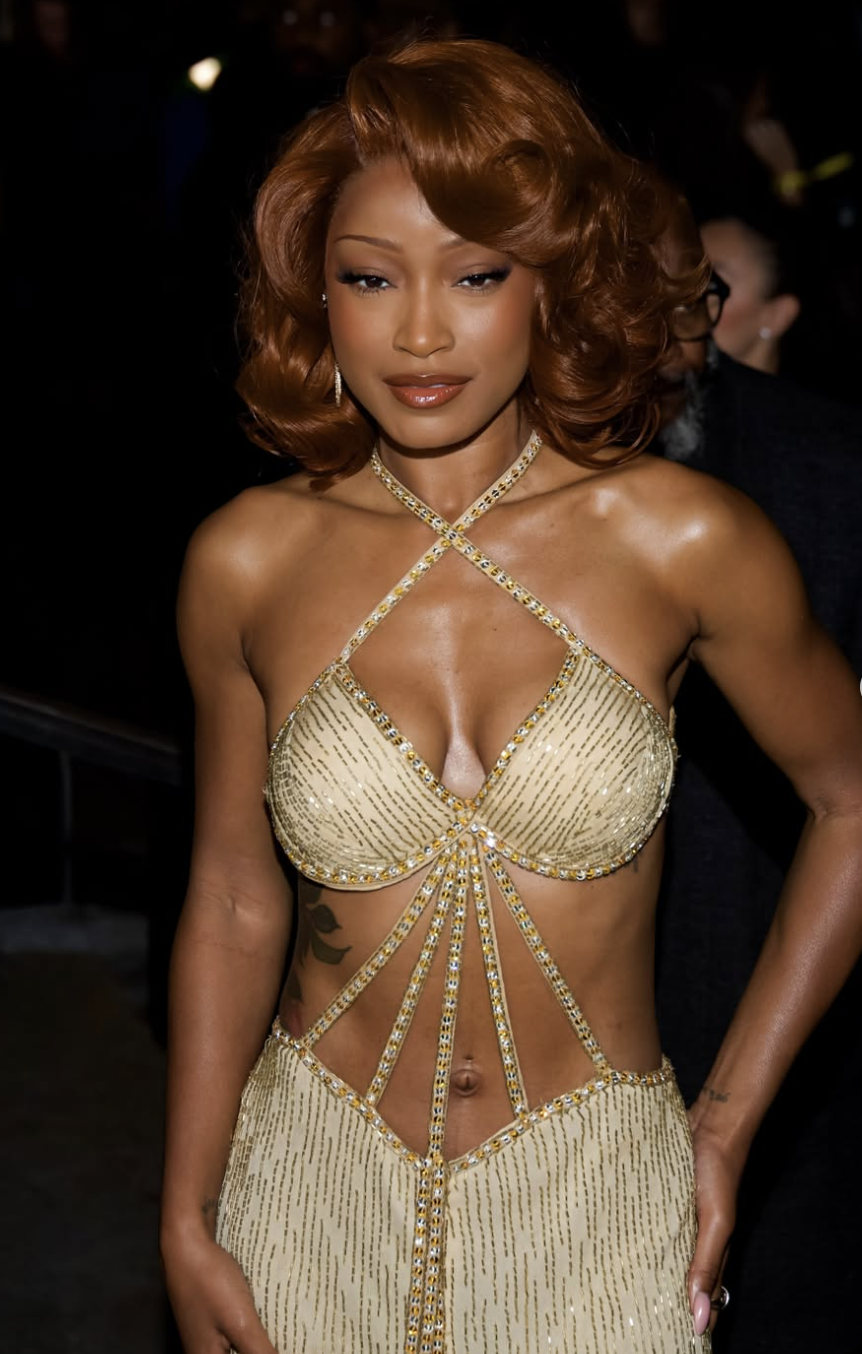
Palmer could have worn a brand-new gown and looked beautiful. Instead, stylist Molly Dickson sourced a rare gold Bob Mackie design from Timeless Vixen a piece originally created for Raquel Welch’s 1975 performance with Cher on The Cher Show.
That history mattered. This was not vintage pulled for the sake of saying it was vintage. It was a performance dress, and Palmer was stepping into a performance role. The narrow straps, body-skimming shape, high slit and light-catching gold surface gave her movement and stage presence without making the dress look overly styled. It felt glamorous, but it also felt alive.
The warm metallic color was especially smart against Palmer’s copper-red hair. I have written before about how well warm, rich shades work with Keke Palmer’s coloring, and this look proved the point without feeling like a color-theory exercise. The gown, hair and red heels all lived in the same warm family, but the styling never became too coordinated or costume-like.
Palmer also understood the assignment in a way some celebrity hosts do not. She did not disappear inside the fashion. The dress carried history, but her personality still came through. That balance—respecting an archival piece without treating it like a museum object—is what made the look feel right for the CFDAs.
Rachel Scott’s win was bigger than one awards-night headline
Scott’s American Womenswear Designer of the Year win for Diotima was the other moment that stayed with me. This was her second time receiving the honor, after her 2024 win, and it felt less like the industry discovering her than recognizing the consistency of what she has built.
Diotima’s power has always been in the conversation between technique and point of view. The label’s crochet is made by artisans in Jamaica, but Scott does not present craft as a decorative afterthought. She places it beside sharp tailoring, sheer layers, sculptural knits and fluid evening pieces, allowing handwork to function as part of the architecture of the clothes.
That approach was visible again in Diotima’s Spring 2027 collection, which pushed beyond the crochet most people immediately associate with the brand. Organza intarsia, viscose knits, horsehair ruffles and precise tailoring expanded the language without abandoning the Caribbean references at its core. Even the sea-toned palette felt connected to place without becoming literal.
That is why the CFDA win matters. Scott is not being rewarded for repeating one recognizable signature. She is building a luxury house with room to evolve. The Jamaican workmanship remains essential, but it is not the only thing carrying the collection. The cut of a jacket, the tension between transparency and structure, and the way texture changes the body all matter just as much.
We saw that same precision when Whitney Peak wore Diotima at the Academy Museum Gala. On the runway and on the red carpet, Scott’s work can hold cultural meaning while still doing the basic job fashion has to do: make the wearer look incredible.
The 2026 CFDA Awards showed two kinds of fashion power
Palmer and Scott represented two different forms of influence.
Palmer’s power was interpretive. She used clothing to connect fashion history to a current audience. Wearing a 51-year-old Bob Mackie dress was not nostalgia for nostalgia’s sake. It placed a Black woman at the center of an American glamour story that began before she was born—and let her make that story feel current.
Scott’s power was structural. Every Diotima collection asks the industry to widen its understanding of what American luxury looks like, where it is made and whose hands are considered part of the authorship. Her win did not solve fashion’s diversity problems, but it did make the night’s most important point: Black cultural perspective and Caribbean craft are not side notes to American fashion. They are helping shape its future.
There were other culturally important names in the nominee pool, including Willy Chavarria in menswear, Raul Lopez of Luar in accessories and Dao-Yi Chow and Maxwell Osborne of Public School NY. That context matters because awards are not only about who takes home a trophy. The nominee list tells us whose work the institution considers central to the conversation.
Still, the night belonged to Palmer and Scott for me. One understood how to wear history. The other is busy writing the next chapter.
The rest of the 2026 CFDA Awards winners
Ralph Lauren received American Menswear Designer of the Year, Ana Khouri won American Accessory Designer of the Year and Colleen Allen was named American Emerging Designer of the Year.
The evening also honored Tory Burch with the Positive Change Award; Inez van Lamsweerde and Vinoodh Matadin with the Geoffrey Beene Lifetime Achievement Award; Anthony Vaccarello with the International Award; Eva Chen with the Media Award; and Linda Fargo with the Founder’s Award. Susan Cianciolo received the CFDA Board of Directors’ Tribute. Peter Marino was named Fashion Icon, and Gap Inc. received the Innovation Award.
The list includes established American names, emerging talent and people whose influence reaches beyond designing clothes. But the strongest story was not simply who won what. It was the way the evening connected archive, identity, craft and the future of American fashion.
You May Also Like:
Cardi B Understands What So Many Celebrities Get Wrong About Fashion Week
Olandria Didn’t Just Attend Milan Fashion Week—She Built a New Fashion Persona
Forget the Outfit for a Second. Spring 2027 Is All About the Jacket.