
How to Use a Wardrobe Inventory Spreadsheet (Free Template)

Photo Credit:MARIA DILLEY
I did not create a wardrobe inventory spreadsheet because I woke up one morning excited to catalog every blouse I own. I created it while moving, surrounded by half-taped boxes, hangers on the floor and clothes I had completely forgotten about.
Every few minutes I would hold something up and ask the same questions: When did I last wear this? Why do I own three versions of it? Where would I even wear it now? The more I packed, the clearer it became that my closet was not actually too small. I simply could not see what was inside it as a whole.
So I opened a blank spreadsheet and started typing. At first, it was not organized or cute. One row said “white puff-sleeve blouse.” Another might as well have said, “black dress I keep packing but never wear.” I was not building a perfect digital closet. I was trying to stop my wardrobe from feeling like a black hole.
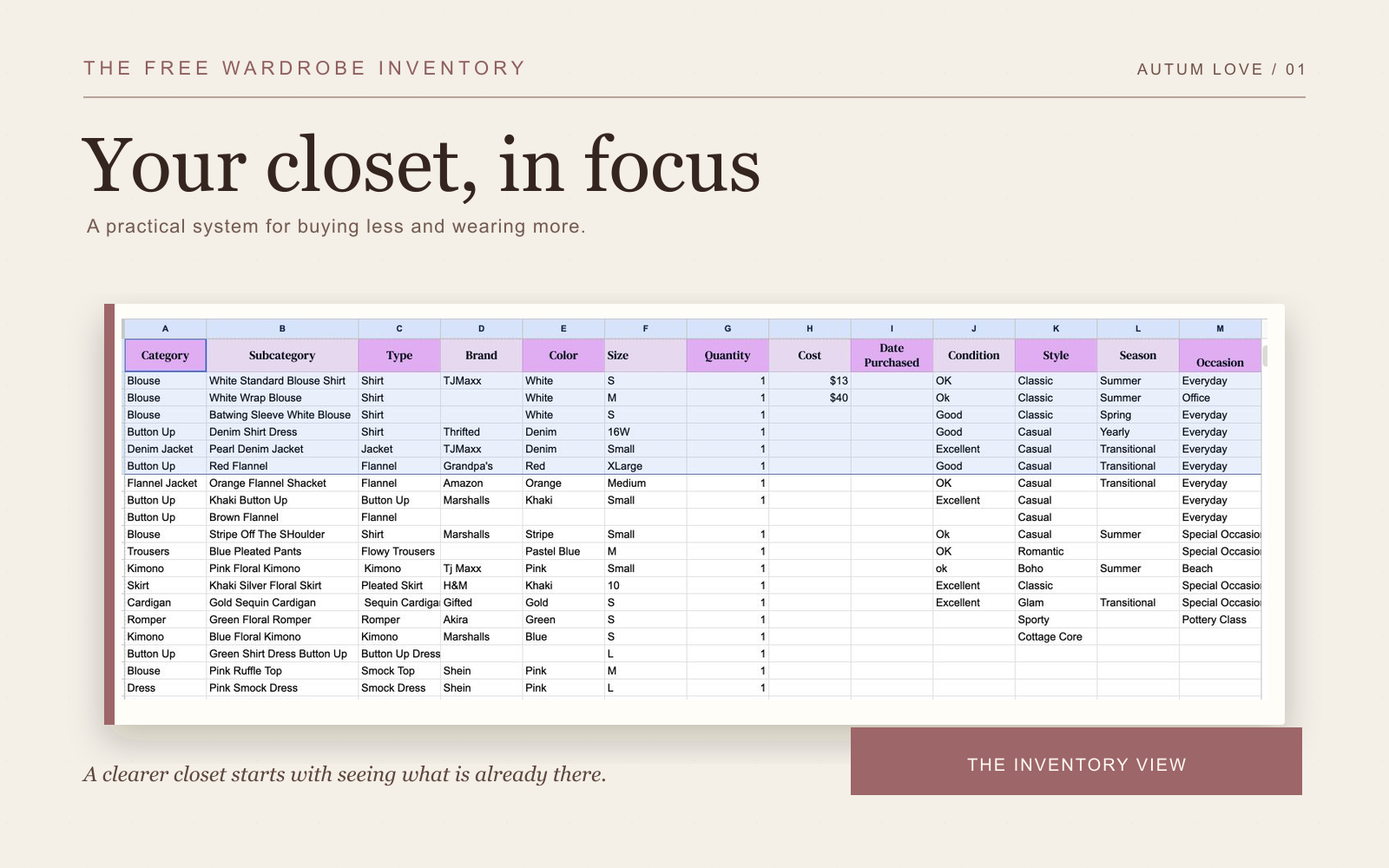
That simple list eventually became the wardrobe system I still use: an inventory for what I own, an outfit planner for how I wear it, a wishlist for the pieces I am considering and a few reference tabs that make the whole closet easier to manage.
DOWNLOAD THE FREE WARDROBE INVENTORY SPREADSHEET
You do not have to build yours from a blank page. Enter your email and I’ll send you the free wardrobe inventory spreadsheet so you can start with the categories already organized.
Why a Wardrobe Inventory Spreadsheet Works Better Than Memory
Most of us can name the pieces we wear every week. We know the jeans by the chair, the cardigan on the back of the door and the sneakers that never quite make it back into the closet. The problem is everything outside that regular rotation.
Your memory tends to show you a highlight reel. A clothing inventory spreadsheet shows you the full cast.
Once the wardrobe is written down, you can sort it by category, color, season, occasion, condition or personal style. Suddenly, “I need more tops” becomes a question you can answer. You may already own plenty of tops—but most of them could be dressy blouses when what your real life needs is a polished knit for school pickup, a casual workday or dinner.
That distinction matters. The goal is not to own the fewest clothes possible. It is to understand whether the clothes you own support the life you actually live.
What My Closet Inventory Revealed
The first surprise was that my closet did not match the style I said I wanted.
I described my style as romantic, but the style column was full of casual basics and sporty pieces. No wonder I felt stuck when I wanted to look softer or more put together. The version of my wardrobe in my head had feminine blouses, easy dresses and thoughtful layers. The version on the hanger had a lot more “fine for errands.”
The occasion column was even more honest. I had enough pieces for brunch and random dressy moments, but far fewer clothes that felt right for meetings, content days and normal work-from-home life. I did not need another fantasy-event dress. I needed everyday clothes with more personality.
That is the value of a wardrobe inventory list: it separates a genuine gap from a shopping mood.
What to Track in a Clothing Inventory Spreadsheet
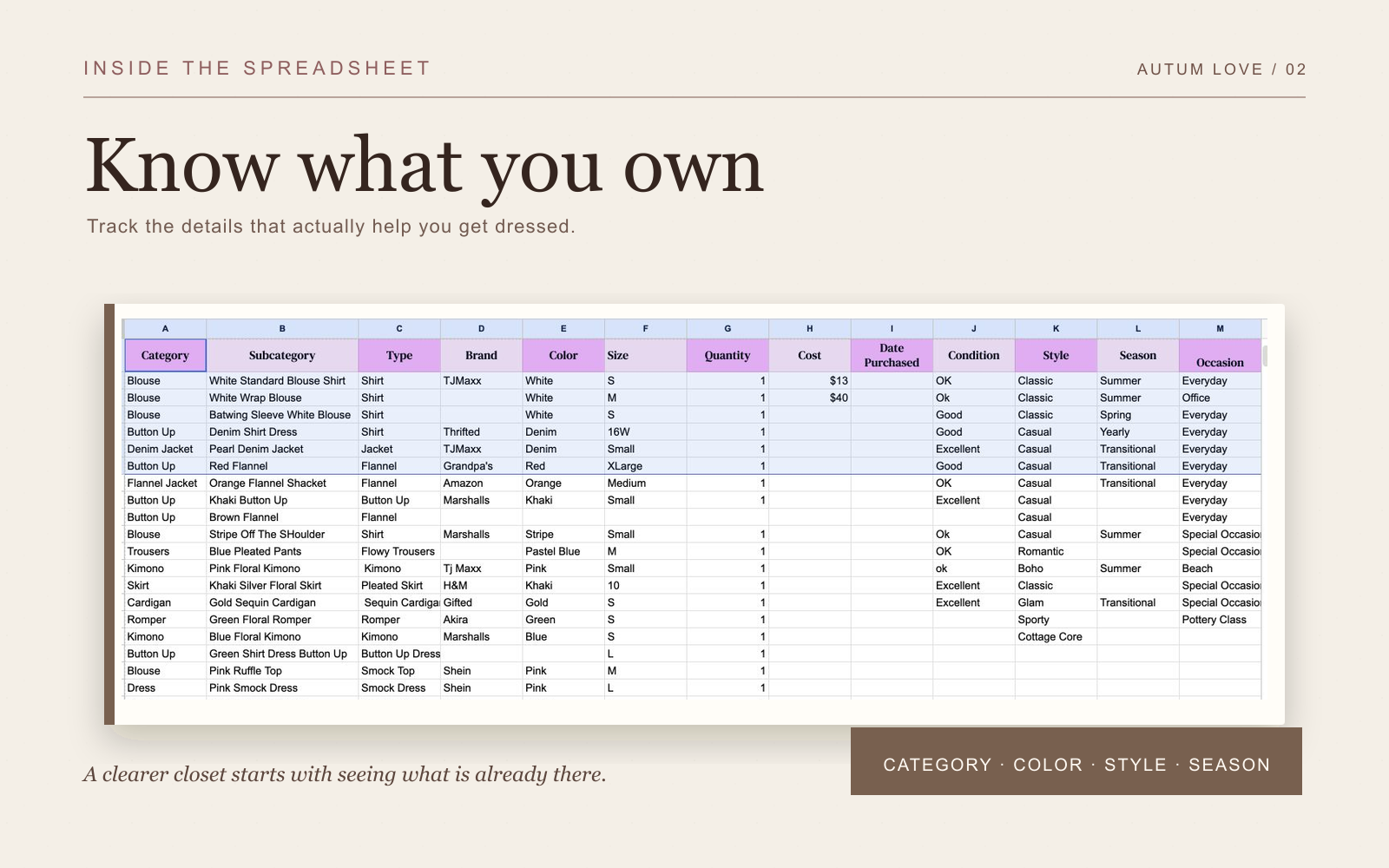
You can make a closet inventory as simple or detailed as you want, but the free template gives you a useful place to begin. The wardrobe inventory tab includes fields for:
Category and subcategory
Item type
Brand
Color
Size and quantity
Cost and purchase date
Condition
Style
Season
Occasion
Notes
You do not have to complete every field on day one. Category, item name, color, season and occasion are enough to make the spreadsheet useful immediately. The other details can be added as you go.
The most revealing columns are not always the obvious ones. Brand and size help with recordkeeping, but style, occasion and notes explain whether a piece belongs in your real wardrobe. “Black midi dress” tells you what an item is. “Dinner, church, client event; needs a lower heel” tells you how it lives.
How to Make a Wardrobe Inventory Spreadsheet Without Losing an Entire Weekend
The fastest way to abandon this project is to pull every item out of your closet at once. Please do not create a clothing mountain on your bed unless you enjoy sleeping beside it.
Use this method instead.
1. Start with one contained category
Choose the easiest category first: jeans, shoes, dresses or jackets. A small, visible win helps you learn the system before you reach the chaotic drawer where every tank top you have owned since 2019 is hiding.
Open the wardrobe inventory tab and enter one item per row. Do not stop to write a beautiful description. “Dark-wash straight-leg jeans” is enough.
2. Use the language you would use while getting dressed
A technically correct description is not always a useful one. If you think of a piece as “the brown meeting cardigan,” use that phrase in the notes. Your spreadsheet should help Future You find an outfit, not impress a retail database.
Be specific about color when it matters. Chocolate brown, warm camel and cool taupe are more helpful than labeling everything brown—especially when you are trying to build outfits in a controlled palette.
3. Tag style, season and occasion honestly
This is where the spreadsheet becomes more than an inventory list.
For style, choose the words that genuinely describe the piece: classic, romantic, casual, sporty, boho, glam or whatever language makes sense to you. For season, think about when you can realistically wear it in your climate. For occasion, describe your actual week—not the imaginary life that convinced you to buy the item.
“Everyday,” “office,” “school pickup,” “date night,” “church,” “travel” and “special occasion” will usually tell you more than vague labels like casual and dressy.
4. Let the notes column be blunt
This is the column for “arms feel tight,” “only works with shapewear,” “needs hemming,” “love with loafers” and “wore once in two years.” The point is not to insult your clothes. It is to record the reason a piece keeps getting skipped.
If the same note appears again and again—itchy, wrong length, difficult bra, needs special shoes—you have learned something valuable about what not to buy next.
5. Stop after 20 to 30 minutes
You are building a tool you can maintain, not taking a final exam. Complete one section, close the laptop and return another day. A finished jeans category is more useful than a half-finished inventory of the entire closet.
How to Use the Outfit Planner Tab
An inventory tells you what you own. The outfit planner turns those pieces into something you can wear.
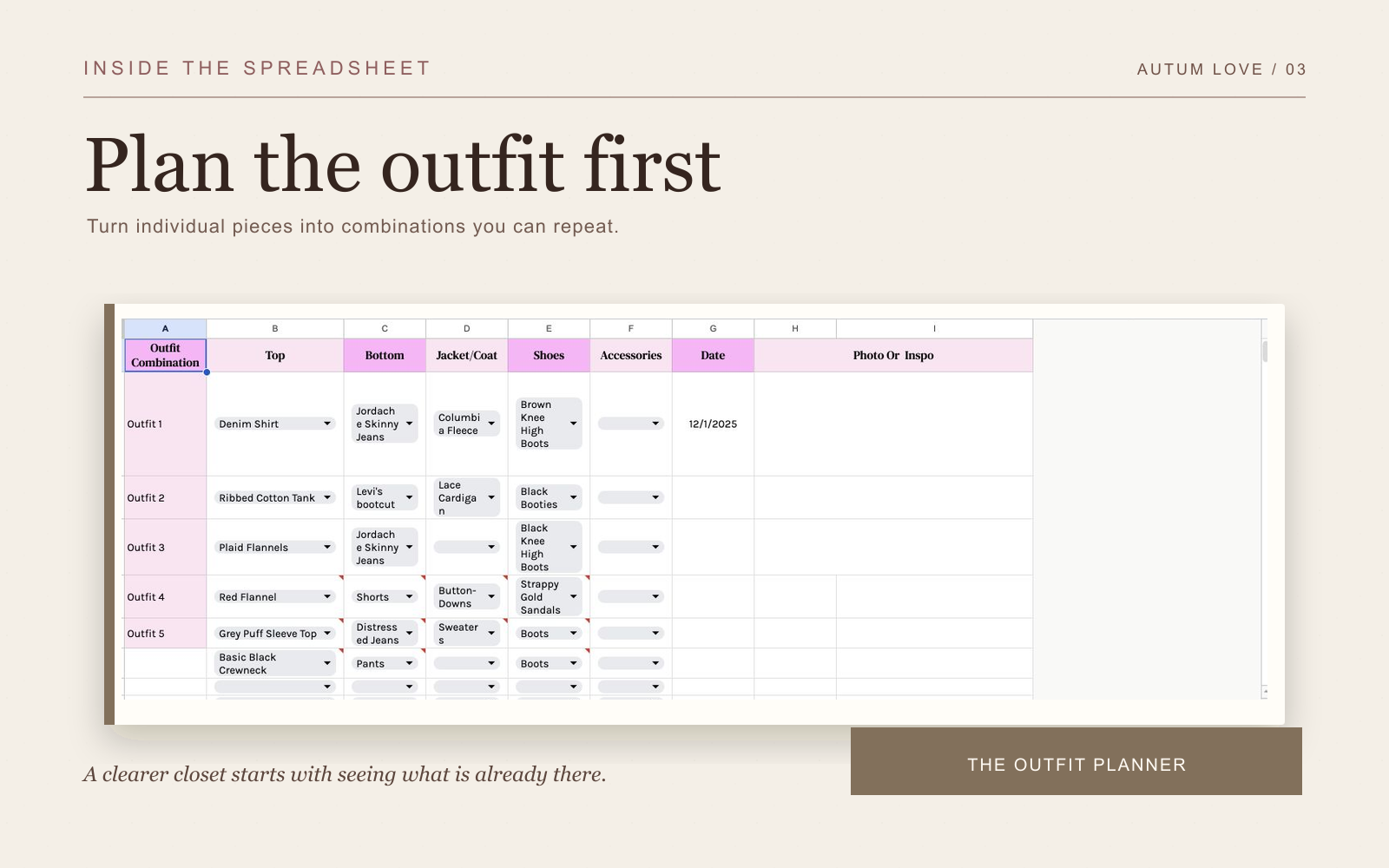
The planner has space for a top, bottom, jacket or coat, shoes, accessories, a date and a photo or inspiration image. I like to use it when I find a combination that worked better than expected. That way, the outfit is not lost the second the laundry gets put away.
Start with five dependable formulas rather than trying to plan a month of unique looks. For example:
Knit top + straight-leg jeans + cropped jacket + loafers
Fitted tank + wide-leg pants + cardigan + flats
Midi dress + denim jacket + sneakers
Sweater + midi skirt + ankle boots
T-shirt + relaxed trousers + statement layer + sandals
Once those formulas are saved, you can swap color, texture or accessories without reinventing the entire outfit.
This is also the perfect companion to an outfit journal. The planner holds the formula; a quick mirror photo shows how it looked and felt in real life.
Use the Wishlist Before You Add to Cart
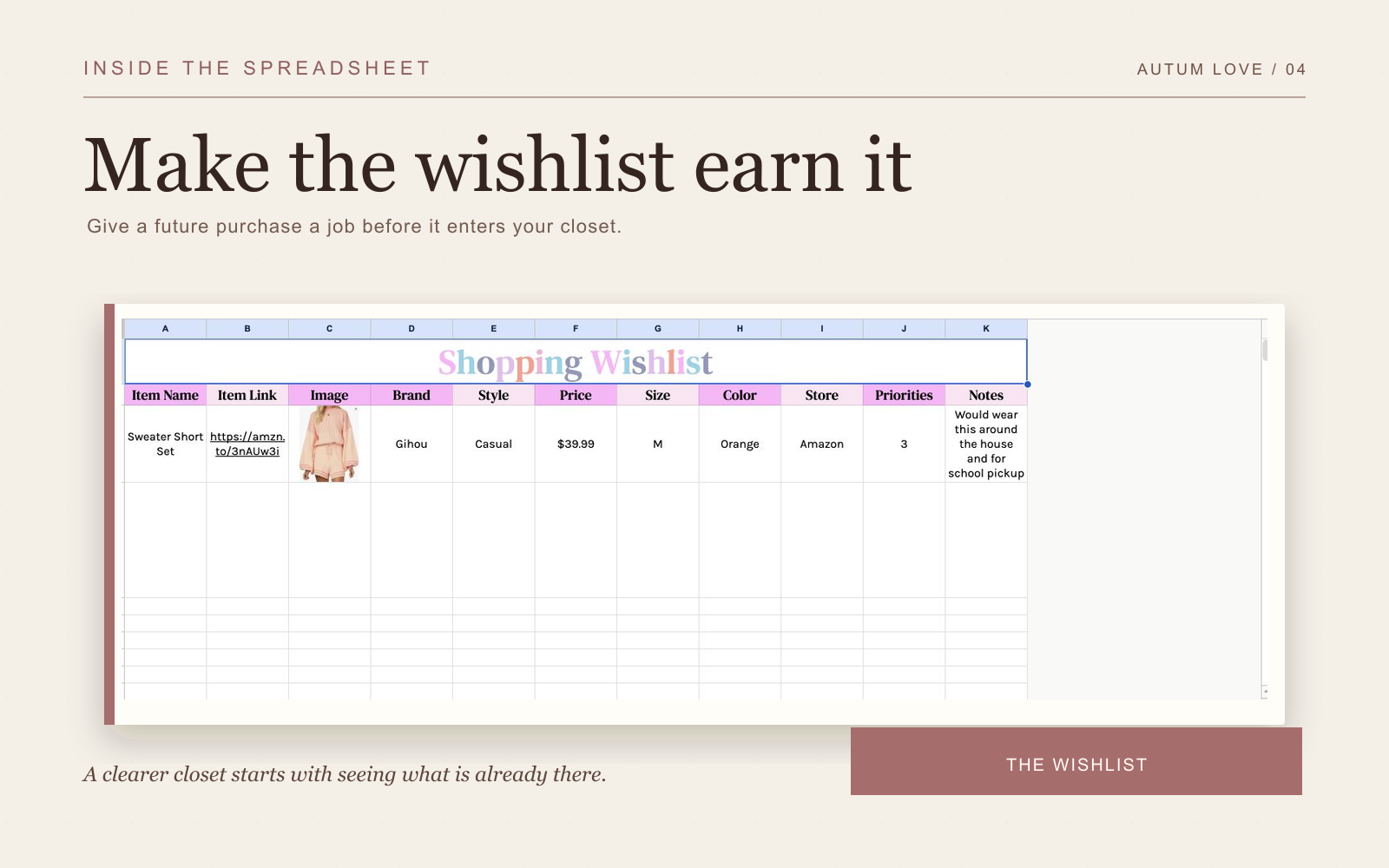
The wishlist tab is my cooling-off period.
Instead of buying a piece the minute it looks cute, add the item name, link, image, brand, price, size, color, store and priority. Then use the notes column to answer three questions:
1. What specific gap does this fill?
2. Which three pieces I already own would I wear with it?
3. Where will I realistically wear it in the next 30 days?
If those answers are fuzzy, the purchase probably is too.
This does not mean you can never buy something simply because it makes you happy. It means the decision gets a little breathing room. I have added plenty of “must-have” pieces to a wishlist and felt absolutely nothing for them a week later. That pause has saved me more money than any sale alert.
Do Not Skip the Fabric Care and Wardrobe Essentials Tabs
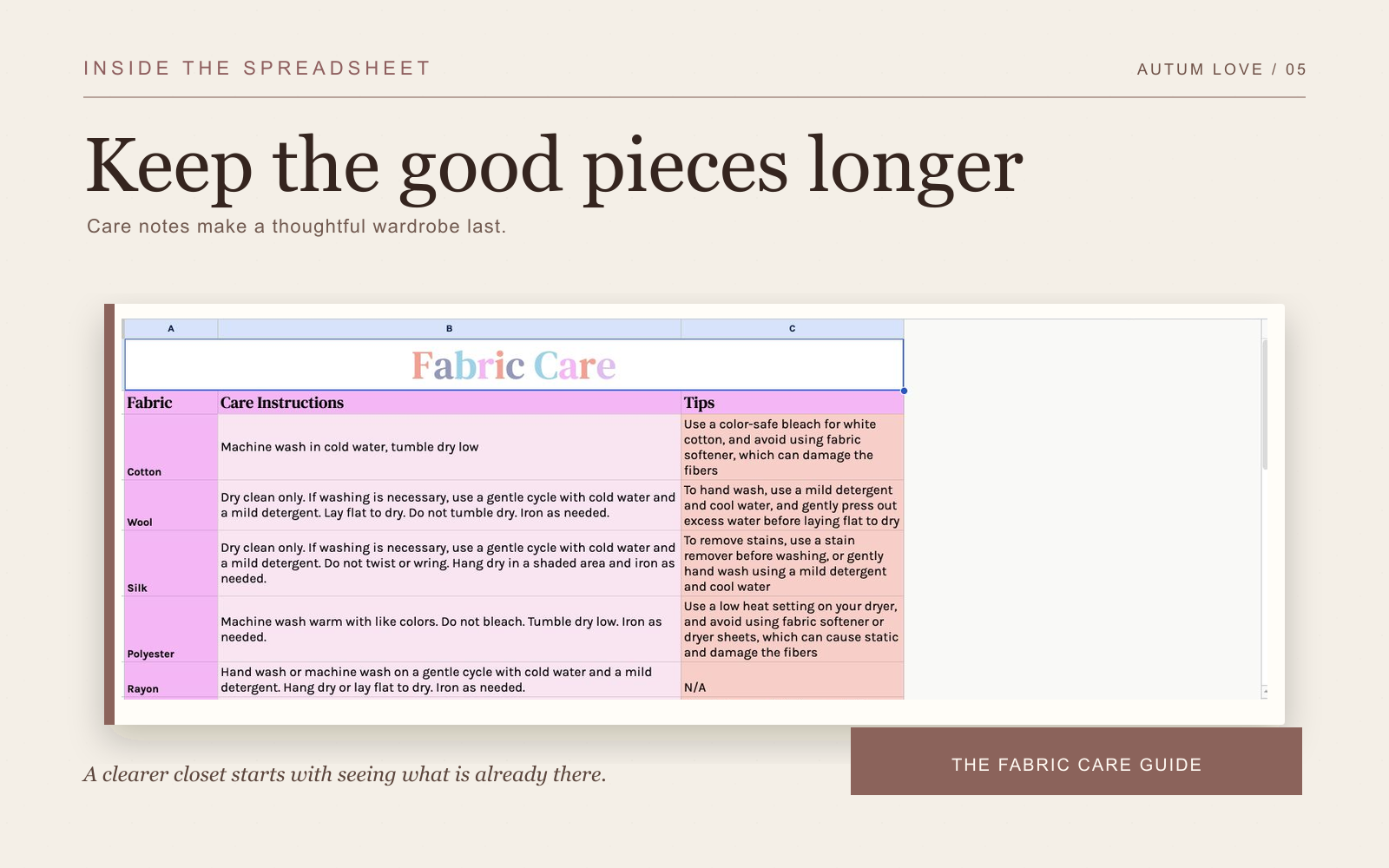
The fabric-care guide is a small tab with an outsized purpose: it helps you keep the pieces you love from becoming laundry casualties. It includes care notes and practical reminders for cotton, wool, silk, polyester, rayon, linen and other common fabrics.
Always check the garment’s own care label first, but use the guide as a quick reference when you cannot remember which knit should lie flat or why high heat is a bad idea for a certain fabric.
The wardrobe-essential tabs cover shirts, pants, skirts, jackets and coats, dresses, shoes and accessories. Treat them as prompts, not a universal shopping mandate. A “classic essential” that does not suit your body, climate or lifestyle is not essential to you.
The goal is to notice a useful omission—not to buy every line on a checklist.
The Real-Life Routine That Keeps My Spreadsheet Useful
I do not update this file every day. A wardrobe system should reduce work, not become another chore sending notifications from your conscience.
Here is the routine that is realistic for me:
At the start of a season: I review what is still in my closet, remove anything I donated and look at the season and occasion columns. This is when gaps become easiest to see.
After a purchase: I add the new piece while the product details and price are still easy to find. It takes less than a minute when I do it immediately.
When an outfit works: I add the combination to the outfit planner or save a mirror photo. Good outfits deserve a second wear.
Before shopping: I check the relevant category and add the potential purchase to the wishlist. This prevents me from buying a fourth version of something while ignoring the actual gap.
When something keeps getting skipped: I update the notes. Sometimes the problem is styling. Sometimes the item needs tailoring. Sometimes it is simply not for me anymore.
The Five Columns to Use If You Hate Spreadsheets
If the full template makes you want to close your laptop, start with only these five columns:
1. Item
2. Color
3. Season
4. Occasion
5. Notes
That is enough to search for “work,” filter for “fall” or see that your closet contains seven black tops and not one layer you enjoy wearing. Add brand, price, condition and other details only if they help you make a decision.
The best closet inventory spreadsheet is not the most detailed one. It is the one you will actually reopen.
What a Wardrobe Spreadsheet Cannot Decide for You
A spreadsheet can show that you own ten dresses. It cannot decide whether any of them make you feel like yourself.
It can reveal that your closet leans sporty. It cannot tell you whether sporty is wrong or simply the style your current life requires.
It can identify repetition, but repetition is not automatically a problem. If you wear a black crewneck four days a week, owning two may be sensible. The numbers are context—not a verdict.
Use the data to ask better questions. Then trust how your clothes fit, feel and function.
Frequently Asked Questions
What is a wardrobe inventory spreadsheet?
A wardrobe inventory spreadsheet is a digital list of the clothes, shoes and accessories you own. It can include details such as category, brand, color, size, season, occasion, condition and styling notes so you can search, sort and understand your closet more easily.
Do I need to photograph every item?
No. Photos can make outfit planning more visual, but they are not required for the inventory to be useful. Start with written entries. Add images later only if they help you recognize pieces or plan combinations.
How long does it take to inventory a closet?
That depends on the size of your wardrobe and how much detail you record. The easiest approach is to work in 20- to 30-minute sessions and complete one category at a time. You do not need to finish in one day.
How often should I update my clothes inventory spreadsheet?
Update it when you add or remove an item, then do a broader review at the beginning of each season. That rhythm keeps the file useful without turning it into daily homework.
Can I use this to build a capsule wardrobe?
Yes. Filter your inventory by season, color, style and occasion to see which pieces can work together and where a capsule has genuine gaps.
For the capsule-specific method, read: How to Use A Wardrobe Inventory Spreadsheet to Build a Capsule Wardrobe
Is the wardrobe inventory template free?
Yes. The template promoted in this article is the free Autum Love wardrobe inventory spreadsheet delivered by email.
Get the Free Wardrobe Inventory Spreadsheet
You do not need a smaller closet before you can feel more organized. You need a clearer view of what you already own.
The free wardrobe inventory spreadsheet gives you a place to catalog your clothes, save outfit combinations, slow down impulse purchases and keep useful wardrobe references together. Start with one category, keep your notes honest and let the system become more helpful over time.
DOWNLOAD THE FREE WARDROBE INVENTORY SPREADSHEET
✦ Creator images used for editorial purposes only. All rights belong to their respective creators. We always link and give credit.
✦ Check Out Our Men's Site
Trending on MensOutfitsDaily